
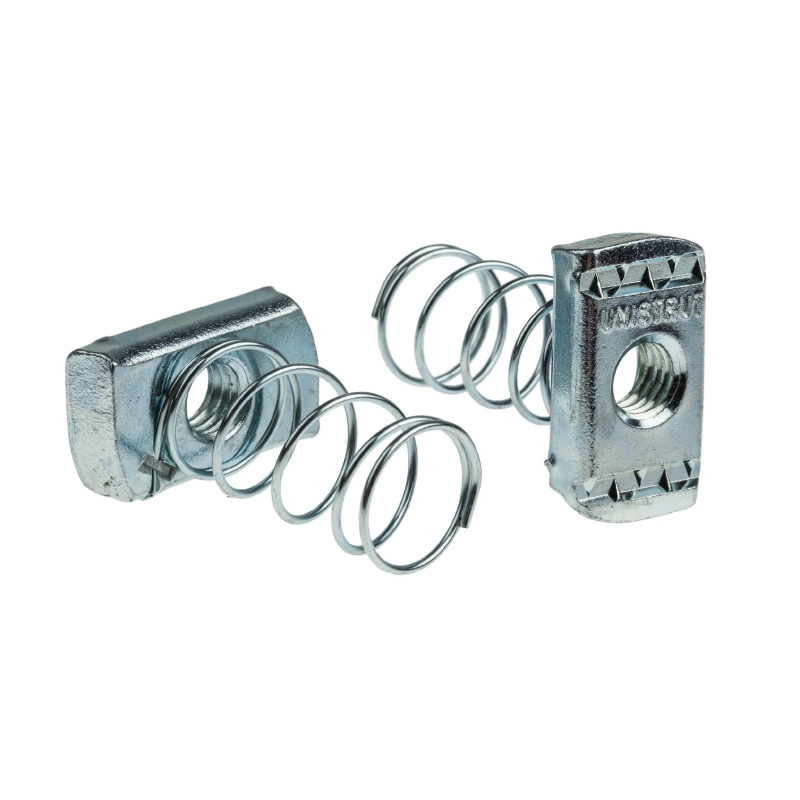
Strut channel spring nuts are fastening components designed to position and secure bolts inside metal framing channels. The attached coil spring holds the nut against the channel lips during assembly, helping installers place brackets, clamps and supports quickly before final tightening. They are widely used in HVAC, MEP, electrical, pipe support, solar mounting and construction systems.
What Is a Strut Channel Spring Nut?
A spring nut—also called a channel nut with spring, strut nut or Unistrut-type spring nut—is a rectangular internally threaded nut assembled with a coil spring. The serrated or grooved face bears against the inward-turned edges of a strut channel. Its spring provides temporary positioning force while the bolt and fitting are installed.
The spring is mainly an installation aid. The completed connection depends on the nut body, channel lips, bolt engagement and specified tightening torque. Buyers should therefore select the nut as part of a compatible channel system rather than by thread size alone.
How Does a Channel Spring Nut Work?
The installer inserts the nut through the channel opening, rotates it approximately 90 degrees and positions it at the required location. The coil spring pushes the nut toward the channel lips, while the serrations help resist movement. A bolt then passes through the bracket or fitting and threads into the nut. Tightening clamps the accessory firmly to the channel.
This design allows components to be added or repositioned without drilling new holes along the full channel length. It is especially useful for modular support assemblies that need fast adjustment during installation.
Spring Nut Sizes and Channel Compatibility
Common metric thread options include M6, M8, M10, M12 and M16, while inch threads may be supplied for markets using UNC specifications. Availability varies by nut body, spring length and channel type.
Before ordering, confirm all of the following:
- Internal thread diameter and pitch
- Channel width, depth and lip geometry
- Nut body width, length and thickness
- Spring length for the selected channel depth
- Bolt diameter, length and property class
- Required working load and installation orientation
A nut that fits into the opening may still be unsuitable if its serrated face does not seat correctly on the channel lips. Samples or channel drawings are recommended when compatibility is uncertain.
Materials, Strength and Surface Finishes
Carbon steel spring nuts are commonly supplied with zinc plating for indoor construction and general industrial use. Other options may include yellow zinc plated, hot-dip galvanized or stainless steel, depending on the project environment and required corrosion resistance.
The nut body, spring and mating bolt may use different materials or coatings. For outdoor, coastal, chemical or high-humidity installations, the complete assembly should be reviewed for corrosion compatibility. Hot-dip galvanized components also require attention to thread allowance because the coating is thicker than ordinary electroplating.
For safety-related support systems, the required material, mechanical properties, proof load, coating thickness and test documentation should be stated in the purchase specification.
Common Applications
Strut channel spring nuts are used to attach accessories and equipment in:
- HVAC duct and equipment support frames
- MEP hanger and trapeze systems
- Pipe clamps and pipe support assemblies
- Electrical conduit and cable tray supports
- Solar panel mounting structures
- Ceiling and building-services suspension
- Industrial machinery frames and modular workstations
They are often used together with threaded rods, channel brackets, washers and industrial nuts. Matching these components as one system helps reduce installation problems and specification mismatches.
Installation and Inspection Guide
- Confirm that the thread, nut body and spring length match the selected strut channel.
- Insert the spring nut through the open side of the channel.
- Rotate the nut so its serrated face aligns beneath the channel lips.
- Slide it to the required position and align the bracket or fitting.
- Insert the correct bolt and engage sufficient threads by hand to avoid cross-threading.
- Tighten to the torque required by the channel-system or project specification.
Inspect the final connection for full seating, correct orientation, adequate thread engagement, undamaged coating and secure contact with both channel lips. The spring must not be treated as the load-carrying element.
Bulk Buying Checklist for Spring Nuts
Overseas distributors, contractors and project buyers can obtain a more accurate quotation by providing:
- Product name: strut channel spring nut
- Metric or inch thread size and pitch
- Channel profile and dimensions
- Nut body dimensions and required spring length
- Material, strength and surface finish
- Required load or test standard
- Order quantity, packaging and marking
- Destination port and delivery requirement
SHENHUI supplies standard spring nuts and can review custom sizes, finishes and packaging for wholesale, OEM and project orders. Buyers can also combine them with threaded rods, bolts, washers and other pipe-support fasteners for coordinated purchasing.
Frequently Asked Questions
Is a spring nut the same as a spring washer?
No. A spring nut is a threaded channel fastener with an attached coil spring. A spring washer is a washer used under a bolt head or nut and serves a different function.
Does the spring carry the installation load?
No. The spring positions the nut during assembly. The tightened nut body, channel lips, bolt and fitting form the load-carrying connection.
How do I choose the correct spring length?
The spring length should suit the depth and geometry of the selected strut channel. Provide the channel drawing or a sample when the system is not clearly specified.
Can you supply custom thread sizes or finishes?
Yes. Non-standard threads, nut dimensions, spring lengths, materials, finishes and packaging can be reviewed according to drawings or confirmed technical requirements.
What information is needed for a quotation?
Please send the thread size, channel dimensions, nut and spring dimensions, material, finish, quantity, packaging and destination.
Request a Spring Nut Quotation
If you source spring channel nuts for HVAC, MEP, electrical, pipe support, solar mounting or construction projects, send SHENHUI your channel profile and fastener list. We can review standard availability, matching components and custom manufacturing requirements.
Contact SHENHUI Fasteners for a spring nut and strut channel quotation or contact us through WhatsApp for urgent bulk purchasing requirements.