
Flange nuts are widely used in automotive assembly, machinery manufacturing, steel structures, electrical equipment and general industrial fastening. Compared with a standard hex nut, a flange nut has an integrated washer-like base that spreads the load over a wider contact area. Serrated flange nuts add locking performance by biting into the mating surface, helping reduce loosening caused by vibration.
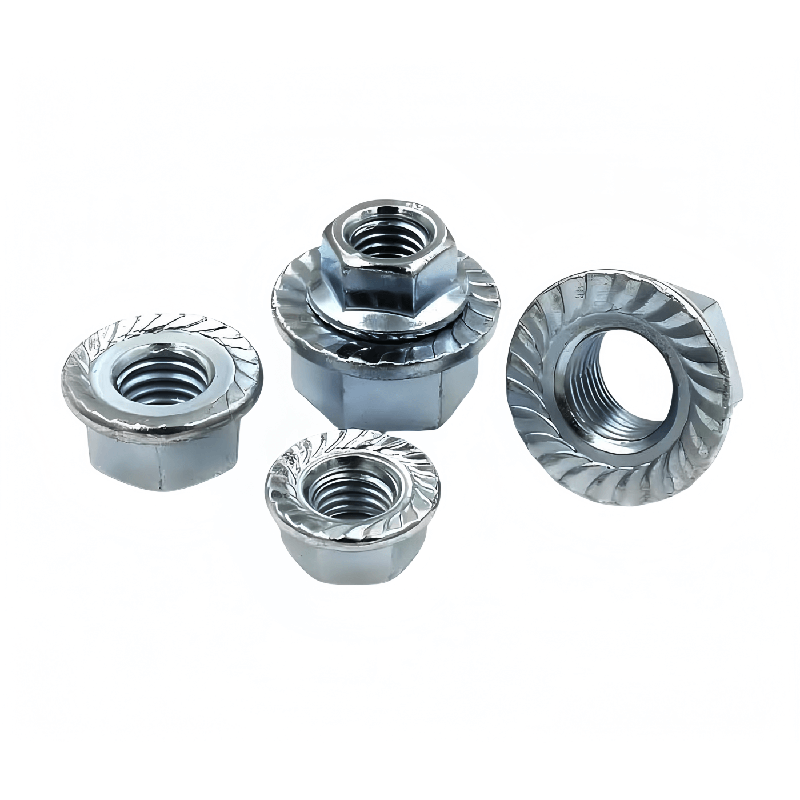
What Is a Flange Nut?
A flange nut is a hex nut with a built-in circular flange at one end. The flange works like an integrated washer, helping distribute clamping force and protect the connected surface. This design can reduce the need for a separate washer, simplify installation and improve assembly efficiency in batch production.
Serrated flange nuts have teeth on the flange face. These serrations grip the surface during tightening, increasing resistance to vibration and rotation. For applications where equipment moves, shakes or experiences repeated load changes, serrated flange nuts are often a practical choice.
Common Standards, Sizes and Materials
Buyers usually specify flange nuts by thread size, standard, material, grade and surface treatment. Common standards include DIN 6923 flange nuts and ISO-style metric flange nuts. Popular sizes include M5, M6, M8, M10, M12, M14, M16 and larger custom sizes for industrial projects.
- Material: carbon steel, alloy steel, stainless steel and customized material options.
- Strength grade: commonly grade 6, 8, 10 or customer-specified mechanical property requirements.
- Surface finish: zinc plated, yellow zinc, black oxide, hot dip galvanized or other anti-corrosion coatings.
- Thread type: coarse thread, fine thread and non-standard thread according to drawing or sample.
Where Are Serrated Flange Nuts Used?
Flange nuts are valued because they combine fastening, load distribution and assembly speed. They are commonly used in automotive brackets, agricultural machinery, equipment frames, metal cabinets, solar mounting systems, rail accessories, construction hardware and electrical support systems.
For importers and distributors, flange nuts are also a high-demand product because they are small, standardized and suitable for bulk stocking. When matched with bolts, threaded rods or studs, they form a complete fastening solution for many industrial customers.
How to Choose the Right Flange Nut
When sourcing flange nuts, price alone is not enough. The thread accuracy, flange diameter, serration quality, surface coating, hardness and packaging consistency all affect customer satisfaction. For vibration-sensitive assemblies, serrated flange nuts can provide better anti-loosening performance than plain flange nuts.
- Confirm the exact standard, such as DIN 6923 or customer drawing.
- Check thread gauge requirements before mass production.
- Select zinc plating or other coating based on the working environment.
- Ask for consistent head shape, clean threads and stable mechanical properties.
- For export orders, confirm carton, bag, pallet and label requirements in advance.
Quality Control for Bulk Flange Nut Orders
For large orders, SHENHUI focuses on key inspection points such as thread pass/no-pass gauge testing, flange diameter, nut height, across-flats dimension, surface finish and packing condition. Stable quality is important for distributors because it reduces complaints, saves sorting time and improves repeat purchasing.
Why Source Flange Nuts from SHENHUI Fastener?
SHENHUI supplies threaded rods, bolts, nuts, washers and anchor fasteners for global customers. We can support standard flange nuts, serrated flange nuts and customized fastening products according to size, coating, grade, packaging and order quantity requirements.
If you are looking for a flange nut supplier for wholesale, distribution, machinery assembly or construction fastening projects, contact SHENHUI for product details, available sizes and quotation support.
Contact SHENHUI Fastener for flange nut quotation and bulk supply.