
Stainless steel eye bolts create a threaded attachment point for lifting, suspension, tie-down and positioning assemblies. They are widely purchased by rigging hardware distributors, machinery manufacturers, marine suppliers and construction contractors. Correct selection requires buyers to confirm the thread system, material grade, load direction, working load and certification requirements—not only the nominal diameter.
What Is a Lifting Eye Bolt?
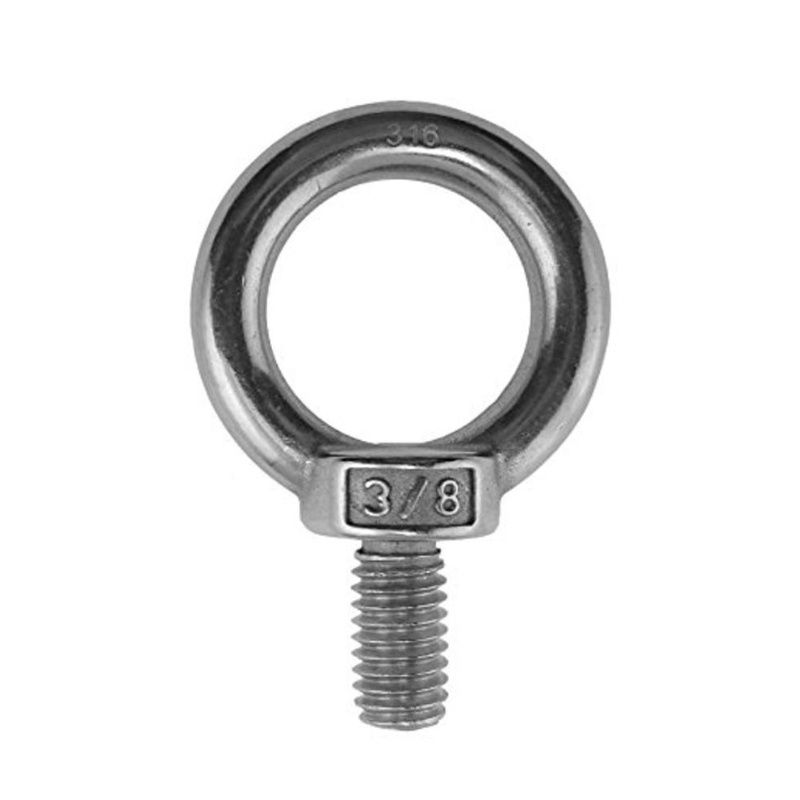
A lifting eye bolt has a closed ring at the top and a male threaded shank below. It screws into a tapped hole or passes through a component and is secured with a compatible nut. The eye provides an attachment point for hooks, shackles, wire rope or lifting slings.
The product shown here is marked 316 and 3/8, indicating a stainless steel eye bolt with an imperial thread size. Metric eye bolts are also widely supplied, including products manufactured to DIN 580 dimensional requirements. The thread system and governing standard must be confirmed before ordering.
Eye Bolt Types
- Shouldered eye bolts: include a shoulder beneath the eye and may support limited angular loading when specifically rated.
- Plain or non-shouldered eye bolts: generally intended for straight axial loading only.
- Machinery eye bolts: screw directly into threaded equipment or components.
- Nut eye bolts: pass through a clearance hole and are secured with a nut and washer.
- Swivel lifting points: engineered assemblies that rotate or pivot to align more effectively with the load direction.
Metric and Imperial Sizes
Common metric eye bolt sizes include M6, M8, M10, M12, M16, M20, M24 and larger diameters. Imperial sizes may include 1/4 inch, 5/16 inch, 3/8 inch, 1/2 inch, 5/8 inch and larger. Diameter alone is not enough: thread pitch or threads per inch must match the receiving component exactly.
- Thread diameter and pitch
- Threaded shank length
- Eye inside and outside diameter
- Shoulder and base dimensions
- Material grade and manufacturing method
- Working load and permitted load angle
- Standard, marking and inspection documentation
DIN 580 and Other Specifications
DIN 580 is a widely recognized dimensional reference for metric lifting eye bolts. However, a DIN designation should not be treated as a substitute for complete technical requirements. Buyers should specify the required material, thread, load rating, marking, test documentation and any market-specific compliance needs.
Imperial eye bolts may follow different dimensional and performance specifications. Never substitute metric and inch threads, even when the diameters appear similar.
316 Stainless Steel and Other Materials
316 stainless steel is selected for its corrosion resistance in marine, coastal, food-processing and many industrial environments. It performs better than standard carbon steel in wet or chloride-containing conditions, although suitability still depends on temperature, chemicals, surface condition and maintenance.
Carbon steel eye bolts can be supplied with self-color, zinc plated or hot-dip galvanized finishes. Hot-dip galvanizing is commonly considered for outdoor construction, while zinc plating provides a clean finish for indoor or mildly exposed service. Material choice must also account for required mechanical properties and certification.
Typical Applications
- Machinery installation and maintenance
- Marine and boat hardware
- Industrial equipment attachment points
- Construction and steel fabrication
- Mold, die and tooling handling
- Wire rope and cable assemblies
- Warehouse and material handling systems
Installation and Safety
Inspect the eye bolt before installation. Do not use a product with cracks, deformation, damaged threads, heavy corrosion or illegible markings. The receiving thread must have adequate strength and sufficient engagement. Seat the shoulder fully against a flat surface when the design requires it, and use suitable washers or spacers only when approved.
Standard eye bolts are strongest under straight axial loading. Side loading, shock loading and multi-leg sling angles can substantially reduce capacity. Non-shouldered eye bolts should not be used for angular loading. Do not force alignment by bending the eye bolt, and never insert a bar through the eye for uncontrolled tightening.
For lifting people, overhead lifting or other safety-critical operations, use only products specifically approved and certified for the task. Follow the rated capacity, lifting plan, inspection schedule and applicable regulations established by qualified personnel.
Quality Inspection Points
- Thread gauge inspection and fit verification
- Material grade and marking checks
- Dimensional inspection against approved drawings
- Surface condition and corrosion-resistance inspection
- Visual examination for forging, casting or machining defects
- Traceability, certificates and packaging verification
- Proof testing or third-party inspection when specified
Bulk Buying Checklist
Importers and distributors should include the following information in an RFQ:
- Eye bolt type and applicable standard or drawing
- Metric or imperial thread size and pitch
- Threaded shank length and required dimensions
- Material grade such as carbon steel, 304 or 316 stainless steel
- Surface finish and service environment
- Working load, load direction and test certificate requirements
- Quantity, packaging, markings and delivery destination
SHENHUI supplies standard fasteners and industrial hardware for wholesale orders and can evaluate custom dimensions, materials, markings, packaging and OEM production. Eye bolts can be sourced together with lifting eye nuts, industrial bolts, nuts and related fastening components.
Frequently Asked Questions
What is the difference between an eye bolt and an eye nut?
An eye bolt has a male threaded shank. An eye nut has a female internal thread and screws onto a stud, bolt or threaded rod.
Is the pictured eye bolt metric?
The photographed product is marked 3/8, which indicates an imperial thread designation. Metric products use markings such as M8, M10 or M12.
Can a standard eye bolt be side loaded?
Many standard eye bolts are intended primarily for axial loading. Angular loading requires a suitable shouldered or swivel lifting point with a verified reduced capacity.
Can SHENHUI supply custom eye bolts?
Custom thread sizes, shank lengths, materials, finishes, markings, packaging and OEM production can be reviewed according to drawings, samples and certification needs.
Request an Eye Bolt Quotation
Send your thread size, dimensions, material, working load, certification requirements, quantity and destination to SHENHUI. Our team will review standard supply and custom manufacturing options.