
High strength socket head cap screws provide high clamping capacity in a compact cylindrical head. Their internal hex drive makes them suitable for machinery, tooling and equipment assemblies where installation space around the fastener head is limited. This buyer’s guide explains DIN 912 and ISO 4762 dimensions, strength classes, thread styles, black finishes, installation points and quality checks for bulk purchasing.
What Is a Socket Head Cap Screw?
A socket head cap screw has a cylindrical head, a flat bearing surface and a recessed hexagon drive. Compared with an external hex bolt, it requires less clearance around the head because tightening is performed from inside the socket. This makes the design useful for recessed holes, counterbores, machine frames, molds, fixtures and compact industrial assemblies.
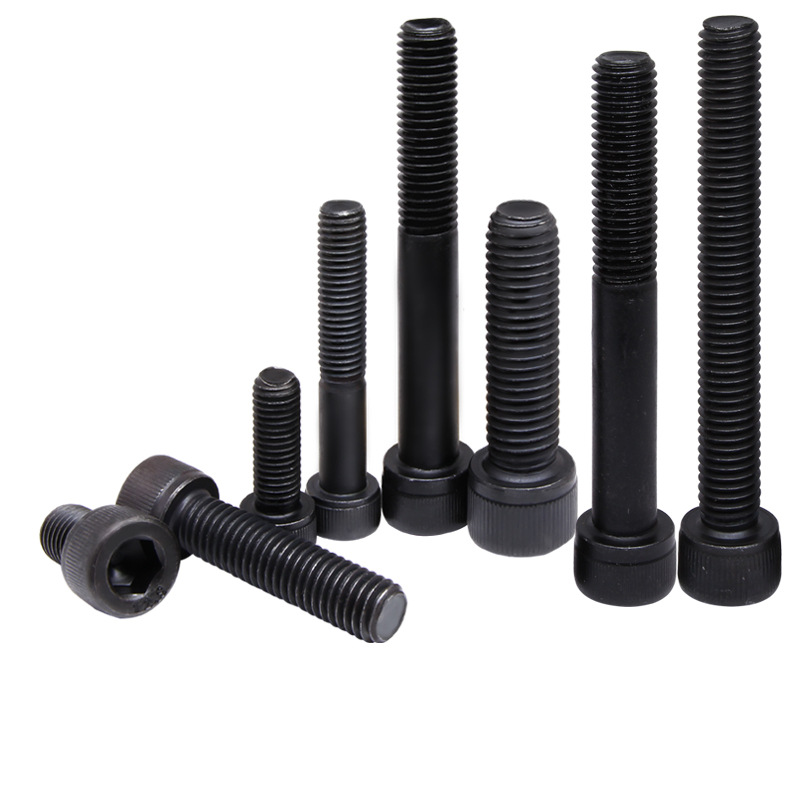
The supplied photograph shows black socket head cap screws in several lengths and diameters, including both fully threaded and partially threaded designs. No property-class marking is visible in the image, so the required strength class must be confirmed in the order specification and inspection documents.
DIN 912 and ISO 4762
DIN 912 remains a familiar purchasing reference for hexagon socket head cap screws, while ISO 4762 is the corresponding international standard widely used for current specifications. Buyers should state the exact standard and edition required rather than relying only on the product name. This is important when replacing an existing component or matching a counterbored hole.
- Metric thread diameter and pitch
- Nominal length measured from beneath the head
- Head diameter and head height
- Internal hex socket size and depth
- Full-thread or partial-thread configuration
- Property class, material and surface treatment
Strength Classes: 8.8, 10.9 and 12.9
Metric alloy-steel socket head cap screws are commonly ordered in property classes such as 8.8, 10.9 or 12.9, depending on the design load and applicable product standard. Class 12.9 is frequently associated with high-strength socket screws, but it should never be assumed from a black finish alone. The designer must select the class based on preload, tensile and shear loads, fatigue conditions, joint stiffness, temperature and safety requirements.
For critical orders, request the mechanical test requirements, hardness range, proof-load or tensile test method, material certificate and lot traceability. The fastener class must also be compatible with the strength of the tapped hole or mating nut.
Full Thread vs Partial Thread
Fully threaded socket head cap screws provide thread engagement along most of the shank and are practical for short grip lengths or adjustable assemblies. Partially threaded screws include a smooth unthreaded shank beneath the head. When correctly matched to the joint, the plain shank can provide improved alignment and place the shear plane away from the threads.
Specify the required grip length, thread length and unthreaded shank length. Two screws with the same diameter and overall length may have different thread lengths under different standards or manufacturer ranges.
Black Finish and Corrosion Protection
The products shown have a black surface, but visual appearance does not confirm the coating system. Black oxide is common for indoor machinery and provides a dark, low-build finish, usually with oil or another supplementary protection. Its corrosion resistance is limited compared with coatings designed for outdoor or humid exposure.
Other options may include phosphate and oil, zinc plating, zinc flake systems or project-specific coatings. For high-strength fasteners, the coating and cleaning process must be controlled to manage hydrogen-embrittlement risk where applicable. State the required finish, coating thickness, color, salt-spray criterion and lubrication condition on the purchase order.
Typical Applications
- Machine tools, automation equipment and industrial machinery
- Molds, dies, jigs and precision fixtures
- Gearboxes, pumps, motors and mechanical assemblies
- Steel frames, brackets and equipment guards
- Automotive and heavy-equipment components
- Maintenance, repair and OEM replacement programs
Application suitability depends on the complete joint design. For lifting, pressure equipment, structural connections or other safety-critical uses, follow the approved engineering specification and applicable regulations.
Installation and Tightening
Use a correctly sized, undamaged hex key or driver and ensure full engagement in the socket. Dirt, coating build-up or a worn tool can round the internal hex. Tightening torque must be based on diameter, pitch, property class, coating, lubrication, mating material and the required preload—not on a generic value copied from an unrelated fastener.
- Clean the internal socket and mating threads before assembly.
- Confirm sufficient thread engagement in the nut or tapped component.
- Use calibrated tightening tools for controlled-preload joints.
- Avoid mixing lubricated torque values with dry fasteners.
- Inspect the bearing surface and counterbore for proper seating.
- Replace fasteners with damaged sockets, threads or corrosion.
Quality Inspection for Bulk Orders
Industrial buyers should define an inspection plan before production. Common checks include thread gauges, dimensional sampling, socket dimensions, head geometry, mechanical properties, surface treatment and packaging identification.
- Dimensions: diameter, pitch, length, thread length, head diameter, head height and socket size.
- Threads: GO/NO-GO gauge results and visual inspection for burrs or damage.
- Mechanical properties: hardness, tensile or proof-load testing as required.
- Surface finish: coating type, thickness, appearance and corrosion requirement.
- Traceability: heat or production lot, inspection record and certificate references.
- Packaging: quantity per box, moisture protection, pallet method and shipping marks.
How to Request an Accurate Quotation
Send the standard, thread diameter and pitch, length, thread style, property class, material, coating, quantity, packaging and destination. Include a drawing for non-standard heads, special shoulders, fine threads, drilled features or customer-specific markings. Shenhui supports bulk fastener supply and custom production after technical review.
Explore our industrial bolt range, compatible nuts and washers. For OEM dimensions and export packaging, view our manufacturing services or send an RFQ.
Frequently Asked Questions
What is the difference between a socket head cap screw and a hex bolt?
A socket head cap screw uses an internal hex drive and needs less clearance around its cylindrical head. A hex bolt uses an external hex head that is tightened with a wrench or socket.
Is DIN 912 the same as ISO 4762?
They cover closely related metric socket head cap screws, but buyers should specify the exact standard and edition required and confirm dimensions for replacement applications.
Does a black finish mean the screw is class 12.9?
No. Surface color does not prove the mechanical property class. Confirm the marking, specification, test results and certificate requirements.
When should a partially threaded socket screw be used?
A partially threaded screw can provide a plain shank through the joint grip for alignment or shear loading. The required thread and grip lengths must match the assembly design.
Can custom lengths, threads and packaging be supplied?
Custom lengths, thread configurations, finishes, markings and export packaging can be evaluated from a drawing or complete specification. Minimum quantities and lead times depend on the production route.
Need high strength socket head cap screws for distribution, OEM production or project supply? Contact Shenhui Fasteners with your size list and technical requirements.