
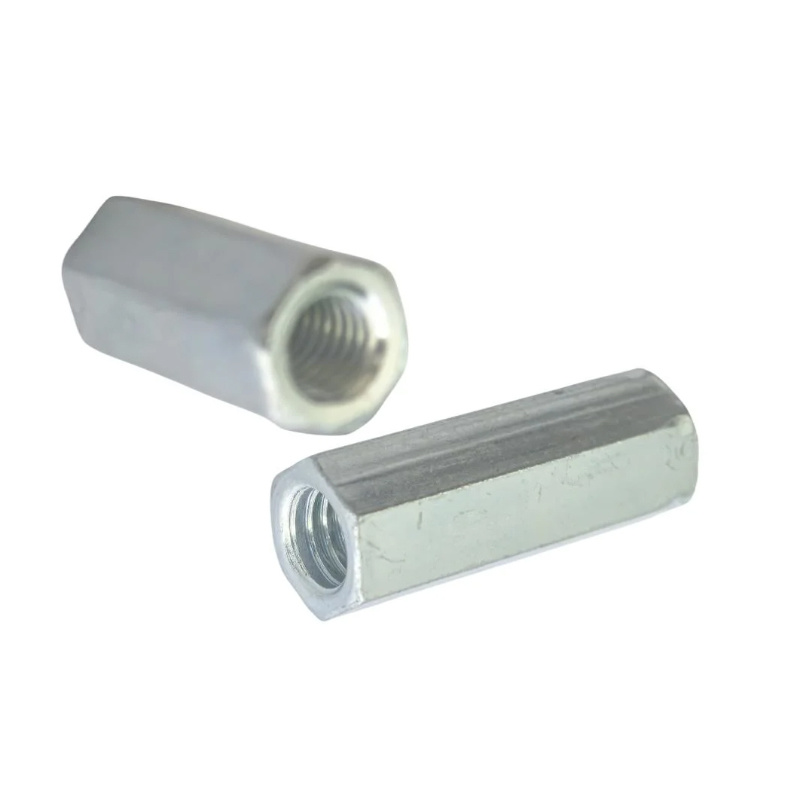
A threaded rod coupling nut is a long internally threaded fastener used to join two male-threaded components in one continuous line. It is commonly used to connect threaded rods, studs and hanger rods in construction, HVAC, MEP, pipe support, machinery and industrial installation systems. Compared with a standard hex nut, its extended body provides a longer thread engagement area and a convenient hexagonal surface for wrench tightening.
What Is a Threaded Rod Coupling Nut?
Coupling nuts are also called rod coupling nuts, extension nuts, connector nuts or long hex nuts. Both ends have internal threads, allowing one threaded rod to enter from each side. When the threads, material and strength are correctly matched, the nut creates a compact connection that can extend a rod assembly or join two threaded components.
The hexagonal outside profile allows installation with a standard wrench or socket. Some projects use inspection holes or witness marks to help confirm thread engagement, while other applications use jam nuts or another specified locking method. The correct arrangement depends on the engineering design and service conditions.
Coupling Nut Sizes, Threads and Standards
Metric threaded rod coupling nuts are ordered by thread diameter and pitch, such as M6, M8, M10, M12, M16, M20 and larger sizes. Inch-series UNC or UNF threads may also be supplied for markets and projects that use imperial fasteners. The mating rod and coupling nut must use the same diameter, pitch and thread direction.
DIN 6334 is a commonly referenced dimensional standard for metric hexagon coupling nuts. However, not every long hex nut is automatically DIN 6334 compliant. Buyers should confirm the required standard, across-flats dimension, overall length, thread tolerance and mechanical properties before ordering.
Important dimensions include:
- Internal thread diameter and pitch
- Overall coupling nut length
- Hexagon width across flats
- Thread tolerance and usable thread depth
- Chamfer and end-face condition
Materials, Strength Grades and Surface Finishes
Coupling nuts are commonly manufactured from carbon steel or stainless steel. Material selection should consider the mating threaded rod, design load, corrosion environment, installation location and applicable project specification.
Common finish options may include:
- Zinc plated: widely used for indoor construction, machinery and general fastening
- Yellow zinc plated: provides a distinctive appearance and corrosion protection based on the specified coating system
- Hot-dip galvanized: often selected for outdoor or more corrosive environments; thread fit must be coordinated with the thicker coating
- Black or plain finish: used where coating is not required or where another protective system will be applied
- Stainless steel: selected for corrosion resistance in suitable environments
A coupling nut should not be selected only by appearance. Its material and mechanical performance must be compatible with the connected threaded rod or stud. For structural, seismic, lifting or other safety-critical connections, the complete joint should be approved by the responsible engineer.
Where Are Threaded Rod Coupling Nuts Used?
Threaded rod connectors are used in many industrial and construction assemblies, including:
- HVAC duct and equipment suspension
- MEP hanger systems and cable tray supports
- Pipe support and trapeze assemblies
- Ceiling suspension and building services installation
- Machinery frames and equipment mounting
- Formwork and temporary construction assemblies where specified
- Maintenance work that requires extension of an existing threaded rod
They can simplify assembly where a single extra-long threaded rod is difficult to transport, manufacture or install. They also make modular support systems easier to adjust, but the connection must still follow the required load and installation specification.
How to Install and Inspect a Coupling Nut
Before assembly, check that the threaded rods and coupling nut are clean, undamaged and correctly matched. Start both rods by hand to reduce the risk of cross-threading. Engage each rod to the specified depth and tighten using the required procedure.
Useful inspection points include:
- Correct thread diameter, pitch and direction
- No cross-threading, burrs or damaged threads
- Adequate engagement from both ends
- Specified locking method, jam nuts or witness marks
- Correct coating condition after installation
- Alignment of the connected rods without unintended bending
Do not assume that inserting each rod only a few turns is sufficient. Minimum engagement and tightening requirements should come from the product specification or project engineer.
Bulk Buying Checklist for Coupling Nuts
For a clear quotation and faster production review, international buyers should provide:
- Product name: hex coupling nut or threaded rod coupling nut
- Required DIN, ISO, ASTM or project standard
- Metric or inch thread size and pitch
- Overall length and width across flats
- Material and required strength or property class
- Surface finish and corrosion-protection requirement
- Quantity, packaging and marking requirements
- Destination port and requested delivery schedule
SHENHUI supplies coupling nuts together with DIN 975 and DIN 976 threaded rod, studs, industrial nuts, bolts and washers. Standard specifications and custom sizes can be reviewed for wholesale, distributor, OEM and project orders.
Frequently Asked Questions
What is the difference between a coupling nut and a standard hex nut?
A coupling nut has a longer body and more internal thread length. It is designed to connect or extend male-threaded components, while a standard hex nut is normally used to clamp an assembly with a bolt or threaded rod.
Can a coupling nut connect two different thread sizes?
A standard coupling nut normally has the same thread on both ends. Reducing coupling nuts with different end threads can be custom manufactured, but both thread specifications must be clearly defined.
Are DIN 6334 coupling nuts suitable for every threaded rod connection?
No. DIN 6334 defines a commonly used metric coupling nut form, but suitability also depends on material, mechanical properties, engagement, coating, load and project requirements.
Can you supply custom lengths and finishes?
Yes. Custom length, thread, material, finish, packaging and marking requirements can be evaluated according to drawings, samples or confirmed specifications.
What should I send for a quotation?
Send the thread size and pitch, length, material or grade, finish, quantity, standard, packaging and destination. A drawing is recommended for non-standard coupling nuts.
Request a Coupling Nut Quotation
If you need threaded rod coupling nuts for HVAC, MEP, pipe support, construction or industrial distribution, send SHENHUI your specification list. We can review matching threaded rods, standard availability and custom manufacturing options for your order.
Contact SHENHUI Fasteners for a coupling nut and threaded rod quotation or contact us by WhatsApp for urgent purchasing requirements.